
Contact Us
181 2883 6688
sunny.lin@hanyueint.com
2501,Block A,Building 3,Hengmingwan Chuanghui Center,Longcheng Street,Longgang District,Shenzhen
The EU “Packaging and Packaging Waste Regulation (PPWR, Regulation (EU) 2025/40)”will officially enter into application on 12 August 2026. Covering all packaging and packaging waste placed on the EU market, it sets unified requirements for sustainability, material composition, recyclability, recycled plastic content, packaging reduction, labelling and producer responsibility.
Notably, 12 August marks the overall application start date, not the full enforcement of all obligations. For example, the PFAS restriction for food contact packaging takes effect on 12 August, while unified packaging labelling will be implemented from 2028 onward. For Chinese exporters and logistics providers handling European DDP and dangerous goods shipments, core focuses at this stage include packaging scope eligibility, restricted substances, exemptions for dangerous goods packaging, and requirements for technical documentation, compliance declarations and producer responsibility.
1. Overview of PPWR
The PPWR (Regulation (EU) 2025/40) entered into force on 11 February 2025 and applies from 12 August 2026 per Article 71. It will replace Directive 94/62/EC (repealed in principle on 12 August 2026 with transitional arrangements for certain provisions) and establish a unified regulatory framework.
It applies to all packaging regardless of material or origin, including packaging from third countries imported with or separately from products into the EU market.
2. Definition of Packaging
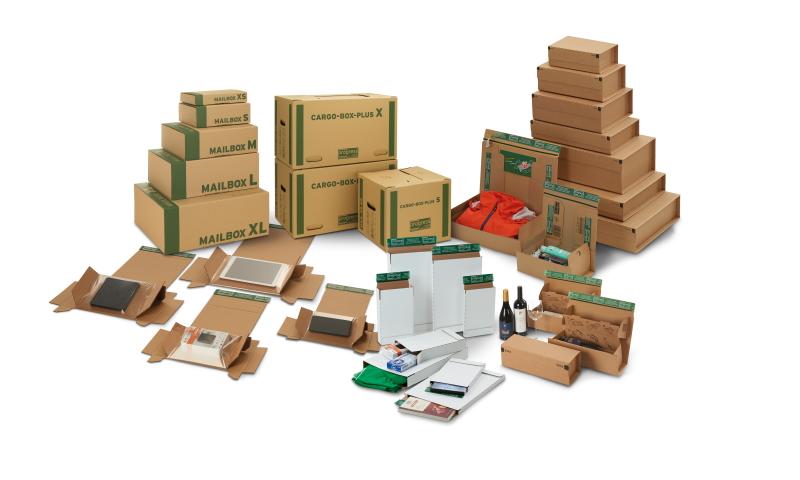
The PPWR provides a harmonised definition, with three core categories covered in Annex XII:
1. Sales packaging
2. Group packaging
3. Transport packaging
Classification is based on the item’s actual function, not whether it forms part of the product itself.
3. Heavy Metal Limits
Per Article 5, the total concentration of lead, cadmium, mercury and hexavalent chromium in packaging or its components shall not exceed 100 mg/kg (subject to exemptions).
Mandatory third-party ISO 17025 testing for all materials is not required; testing necessity and methods shall be determined based on specific materials and compliance needs.
4. PFAS Restriction for Food Contact Packaging
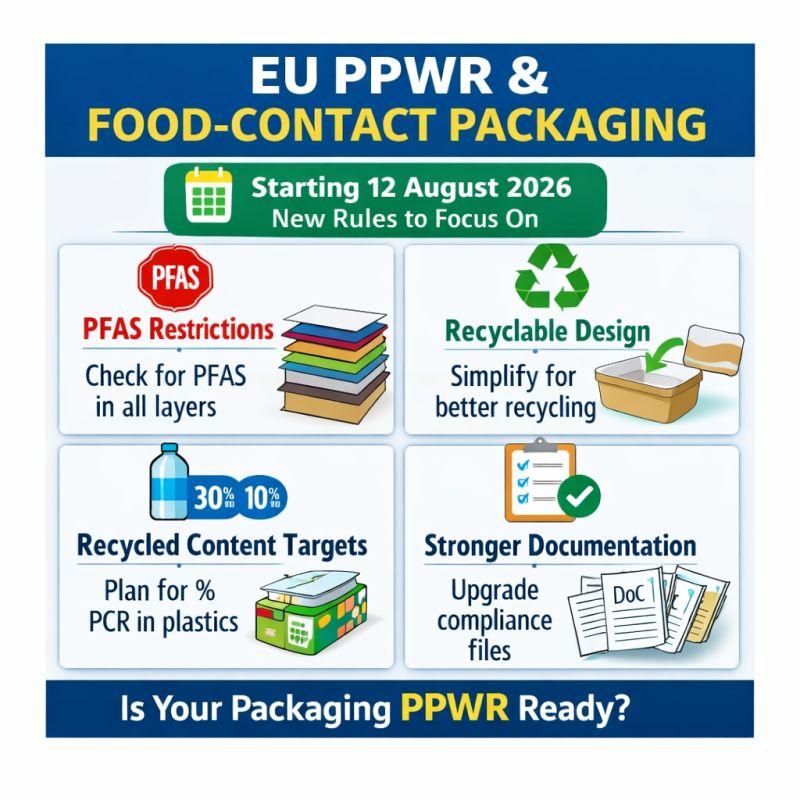
Effective 12 August 2026, food contact packaging must comply with three PFAS concentration limits (corresponding to different testing methodologies):
- Individual PFAS: 25 ppb
- Sum of PFAS: 250 ppb
- PFAS (including polymeric PFAS): 50 ppm
This rule applies “only to food contact packaging”, not all export packaging. It does not automatically apply to transport packaging for general industrial goods, chemicals or dangerous goods.
5. Recycled Plastic Content Requirements
From 2030, eligible plastic packaging must meet minimum recycled material ratios:
- 30% for PET-based contact-sensitive packaging (excluding single-use beverage bottles)
- 10% for other plastic contact-sensitive packaging (excluding single-use beverage bottles)
- 30% for single-use plastic beverage bottles
- 35% for other plastic packaging
Ratios will rise further by 2040 (e.g., 65% for other plastic packaging).
“Key exemption”: Packaging used for dangerous goods transport under Directive 2008/68/EC is excluded from the recycled content requirement (Article 7). This exemption applies only to recycled content obligations, not to the PPWR as a whole.
6. Packaging Minimisation
From 1 January 2030, manufacturers must reduce packaging weight and volume to the minimum necessary for its function; importers must verify compliance before placing goods on the market.
Designs whose sole purpose is to increase apparent product volume may be prohibited, but functionally necessary structures (for transport safety, hygiene or dangerous goods compliance) are not automatically non-compliant. Dangerous goods packaging cannot be arbitrarily thinned or lightened.
7. Packaging Labelling Timeline
Unified packaging material labelling will apply in principle from 12 August 2028 (or 24 months after relevant implementing acts enter into force, whichever is later).
It is not enforced in 2026. Certain transport packaging is exempt from consumer labelling obligations, while e-commerce packaging is subject to special rules.
8. Obligations for Importers and Supply Chain Operators
Importers must verify compliance assessments, technical documentation and labelling before placing packaging on the market. Manufacturers must conduct conformity assessments and maintain technical documentation.
Per Annex VII, technical documentation includes packaging description, design, materials, specifications, assessment reports and test results, to be retained for 5 years (single-use packaging) or 10 years (reusable packaging).
9. Key Notes for Dangerous Goods DDP Business
Two core focus areas:
1. Confirm whether the goods’ packaging falls within the PPWR scope
2. Confirm eligibility for special rules or exemptions for dangerous goods transport packaging
Freight forwarders may verify the following with customers: product category, packaging type and material, dangerous goods status, food contact status, plastic content, restricted substance involvement, and target EU member state.
DDP terms alone do not determine liability under the PPWR. Responsibility is assessed based on contractual arrangements, customs declaration entity, market placement conduct and national regulations.
10. Extended Producer Responsibility (EPR)
Member states will establish producer registration systems for packaging waste management. EPR registration, declaration and liability procedures vary by country — there is no single uniform EU-wide process. Requirements for Germany, France, the Netherlands, Italy and other markets shall be confirmed against local rules.
11. Clarification of the 12 August 2026 Milestone
Key timeline under Article 71:
- 11 Feb 2025: Regulation enters into force
- 12 Aug 2026: Regulation enters into overall application
- 12 Aug 2026: PFAS restriction for food contact packaging takes effect
- 12 Aug 2028: Unified packaging labelling applies in principle
- 2030: Recycled content and packaging minimisation requirements take effect
- 2040: Higher recycled content ratios take effect
The 12 August 2026 date does not mean full simultaneous enforcement of all PPWR requirements.
TIPS
As EU green compliance thresholds rise, packaging has become a mandatory entry requirement for cross-border exports.
Hanyue International will continue to track updates on EU PPWR, EPR and dangerous goods transport policies, and support customers with packaging compliance planning and logistics arrangements for the European market. For enquiries on specific product packaging requirements, please contact our customer service team.